
Best Age for Your Child to Get Orthodontic Braces
Every parent asks this question. The honest answer is — it depends. But the window you must not miss is between 7 and 14 years.
See the Signs Your Child Needs BracesWhy Does Age Matter So Much in Orthodontics?
Your child’s jaw is not just bone. Up to around age 14, it is still soft and growing. That is the window an orthodontist uses. During this time, teeth move faster, treatment is shorter, and results last longer.
After age 16 or 17, the jaw hardens. Braces still work — but correction takes more time, more visits, and sometimes teeth need to be removed to create space. More visits means higher cost. More time means more months of discomfort. All of this can very often be avoided simply by starting at the right age.
The right age is not one number. It is a window. And you want to catch your child inside that window — not after it closes.
AAO Recommendation: The American Association of Orthodontists (AAO) recommends every child have their first orthodontic evaluation by age 7 — not to start braces, but to spot problems early before they become bigger and more expensive to fix. (Source: American Association of Orthodontists Clinical Guidelines)
At age 7, the first adult molars have come in. A qualified orthodontic evaluation can see the full picture of how the jaw and teeth are developing — even before all baby teeth are gone. That early look can save you significant time, money, and pain later.
Parents in Gurgaon — especially in areas like Sector 51, Sector 56, Golf Course Road, and Sohna Road — often ask us: “My child’s teeth look a little crooked but not too bad. Should I wait?” The honest answer is: an evaluation costs very little and tells you exactly where your child stands. Waiting without knowing is the real risk.
What Happens at Each Age — A Simple Guide for Parents
This is not a one-size-fits-all answer. Here is what to expect and do at each stage.
Early Watch Phase
- First adult teeth coming in
- First orthodontic evaluation recommended
- No braces usually needed yet
- Jaw expanders may be used for serious bite issues
- Habit correction (thumb sucking, mouth breathing) starts here
The Golden Window
- Most permanent teeth have erupted
- Jaw bone still flexible — teeth move faster
- Best time to start full braces treatment
- Treatment is typically 18–24 months
- Bite correction is much easier at this age
Late Teens — Still Good
- All permanent teeth fully in by now
- Braces still very effective at this age
- Jaw hardening begins — treatment may take longer
- Clear aligners like Invisalign are a popular choice
- Better compliance with instructions than younger kids
| Age Group | Jaw Status | Typical Action | Treatment Time |
|---|---|---|---|
| 6–9 years | Very flexible, growing fast | Evaluation, expanders if needed | Depends on issue |
| 10–13 years | Still soft — ideal for movement | Full braces or aligner treatment | 18–24 months typically |
| 14–17 years | Hardening, but workable | Braces or aligners — still excellent results | 18–30 months |
| 18+ years | Fully set | Braces work — just slower, may need extraction | 24–36 months |
Signs Your Child May Need Braces — Look for These
You do not need to be a dentist to notice these signs. If your child has any of these, book an orthodontic evaluation. Do not wait for the school dentist to say something.
- Crowded or overlapping teeth
- Teeth that stick out in front (protruding)
- Top teeth covering too much of the bottom (deep bite)
- Bottom teeth biting in front of top teeth (underbite)
- Gap between front teeth when biting (open bite)
- Child breathes mostly through the mouth
- Thumb sucking habit past age 5
- Difficulty chewing or biting food
- Teeth not meeting properly when mouth closes
- Baby teeth falling out too early or too late
- Jaw makes clicking sounds
- Child feels embarrassed about their smile
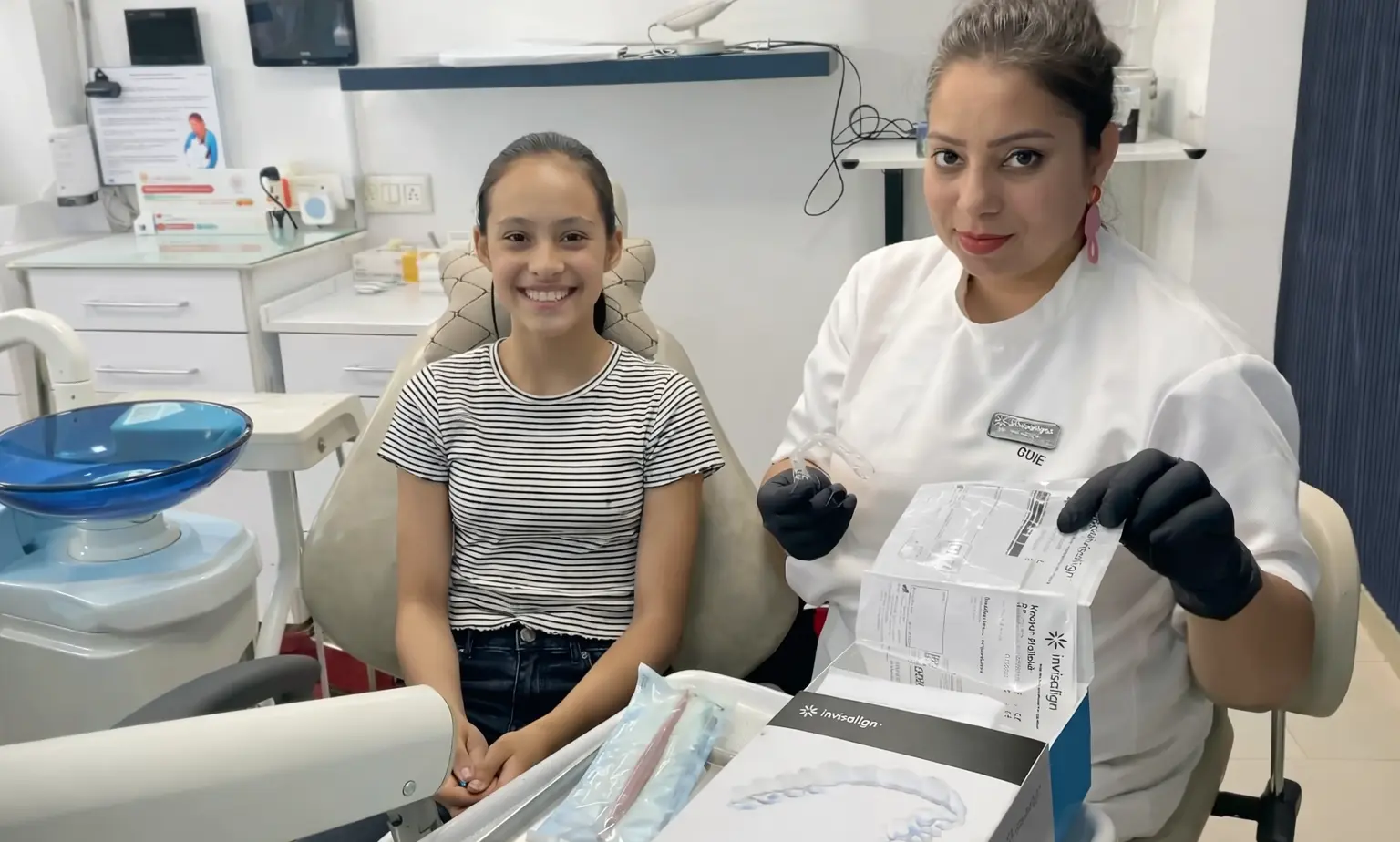
Early orthodontic evaluation — the first visit that changes everything
One thing I see often at our clinic — parents bring their child only when the crowding is very obvious. But by then, we have already missed some of the easier correction window. Even if your child’s teeth look “okay,” an evaluation at age 7 takes only 20 minutes. It gives you a clear plan — and peace of mind.
If your child is a teenager and you are wondering whether braces or clear aligners would suit them better, that is also something we assess during the evaluation. For mild to moderate cases in teens above 14, Invisalign in Gurgaon is often an excellent option.
Spotted one of these signs in your child?
Do not wait. Early evaluation at Center for Dental Implants & Esthetics, Gurgaon takes only 20 minutes.
What Happens If You Delay Your Child’s Braces?
This is not meant to scare you. But most parents who come late say the same thing: “I wish we had come earlier.” Here is what actually changes when you delay.
Longer Treatment Time
After age 14, jaw bone hardens. Teeth move more slowly. A case that takes 18 months at age 12 may take 28–30 months at age 16. More months, more visits, more cost.
Tooth Extractions May Be Needed
When the jaw is still growing, a palate expander can create space naturally. Once growth stops, that option closes. Crowding then often requires removing healthy premolar teeth — which is avoided in early treatment.
Higher Overall Cost
Longer treatment = more adjustment visits. Extractions = additional procedures. Complex cases = more advanced mechanics. Early treatment is almost always more straightforward — and more affordable — than delayed treatment.
Jaw Problems Cannot Be Fixed Later
Jaw width, bite direction, jaw position — these can only be guided during active growth. After the jaw is fully formed, only braces for teeth are possible. Jaw-level correction requires surgery in adults. Early intervention avoids this entirely.
Crooked Teeth Damage Themselves
Overlapping and misaligned teeth trap food and plaque in areas a toothbrush cannot reach. Over years, this leads to cavities, gum disease, and uneven wear on tooth surfaces — all of which need separate treatment.
Confidence Takes a Hit
Children who feel embarrassed about their smile during school years often avoid smiling in photos, avoid speaking up in class, and carry that hesitation into their teenage years. Addressing this early has a real impact on confidence and social development.
Bottom Line
In our clinic at Center for Dental Implants & Esthetics, Gurgaon — the children who start treatment between 10 and 13 almost always have shorter, simpler, and more comfortable journeys than those who come at 15 or 16. The biology is simply more in your favour when you start earlier.
What Is Two-Phase Orthodontic Treatment?
Some children need treatment in two separate stages. This is called two-phase treatment. Not every child needs this — but when it is recommended, starting early makes a big difference.
Phase 1 — Ages 6 to 9
This phase targets jaw problems, not just crooked teeth. If your child’s upper or lower jaw is growing the wrong way, early devices like palate expanders can guide the jaw into the right shape.
When this is done early, Phase 2 (full braces later) becomes much shorter and easier. It can even help avoid tooth extractions.
- Palate expanders to widen the jaw
- Partial braces for severe cases
- Habit-breaking appliances (thumb sucking, tongue thrusting)
- Duration: usually 6–18 months
Phase 2 — Ages 10 to 14
This is the full braces phase. All or most adult teeth are now in place. The orthodontist uses braces or aligners to align every tooth and correct the bite.
- Full metal, ceramic, or self-ligating braces
- Clear aligners for suitable cases
- Duration: 18–24 months typically
- Followed by a retainer to hold results
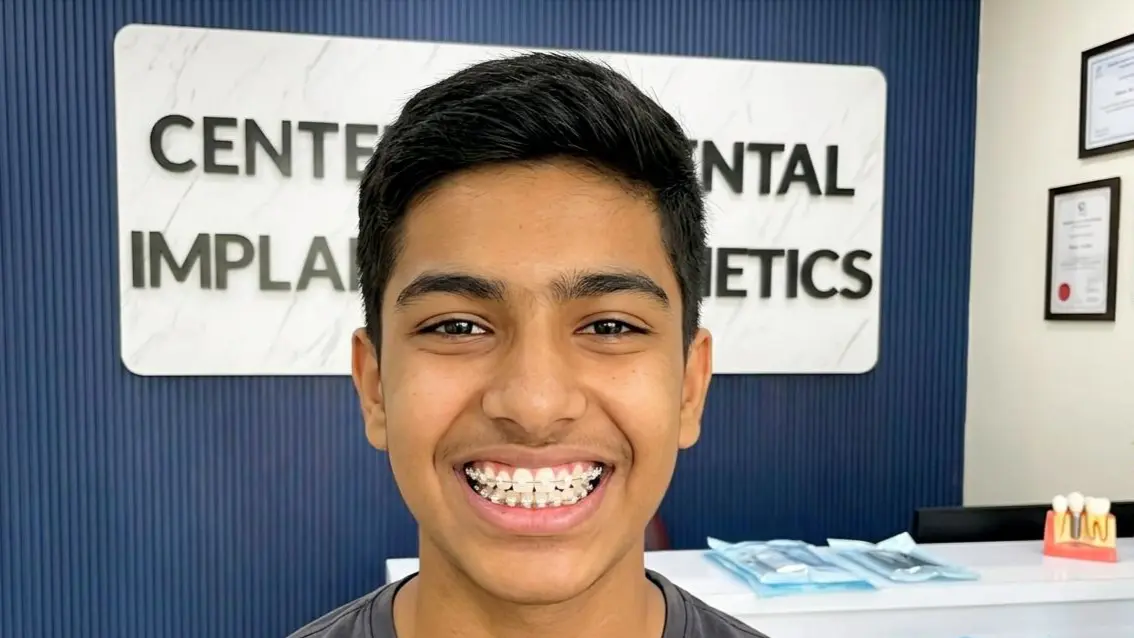
Braces Myths Every Parent Believes — and the Truth
Wait until all adult teeth are in before seeing an orthodontist.
The AAO recommends evaluation by age 7. Early detection means easier, shorter treatment later.
Braces are only cosmetic — just for looks.
Crooked teeth trap more plaque, cause uneven biting pressure, and can lead to jaw pain and cavities over time.
My child is too young for braces at age 8.
Some children benefit from early intervention (Phase 1) precisely because the jaw is still forming at that age.
Braces make teeth weaker.
Properly aligned teeth are stronger, easier to clean, and less prone to fracture and gum disease.
What to Expect When Your Child Gets Braces
Knowing what happens step by step makes it much less scary — for you and your child.
-
01
Orthodontic Evaluation
X-rays, photographs, and study models of the teeth are taken. The orthodontist maps out your child’s bite, jaw growth pattern, and tooth alignment. This is when the treatment plan is made.
-
02
Braces Are Placed (Bonding Day)
Brackets are glued to each tooth and connected with a wire. This takes about 60–90 minutes. There is no pain during this — only mild pressure.
-
03
Monthly Adjustments
Every 4–6 weeks, the wire is tightened. Your child may feel soreness for 1–3 days after each visit. Soft foods help. Paracetamol (as prescribed) manages discomfort well.
-
04
Braces Come Off
After treatment (usually 18–24 months), the braces are removed. Teeth are cleaned and polished. The result is visible immediately.
-
05
Retainer Phase — The Critical Step
After braces, a retainer is must. Without a retainer, teeth can shift back. Your child will wear it full-time initially, then only at night. This phase protects the entire investment of treatment.
Brushing with braces matters more. Brackets and wires trap food. Your child needs to brush after every meal — not just morning and night. An interdental brush (small bottle-brush type) is very helpful. If cleaning is poor, white marks can appear on teeth permanently when braces are removed.
What I See Every Day in Our Clinic
“In my 17 years at Center for Dental Implants & Esthetics, I would say more than half the teenage patients I see could have had a much simpler treatment if they came just 2–3 years earlier. The pattern is always the same — parents from Sushant Lok, DLF, South City, Sector 56 bring their 14 or 15 year old and say ‘doctor we thought the teeth will settle on their own.’ Misaligned teeth almost never self-correct. What I have seen repeatedly is this: a child who starts treatment at 11 finishes in 18 months. The same problem starting at 15 takes 28 months and sometimes needs a premolar removed. That extraction — that is what we are trying to save your child from. My one request to every parent: bring your child for an evaluation at age 7. You do not have to commit to anything. Just know where you stand.”
At Center for Dental Implants & Esthetics in Gurgaon, we use digital orthodontic planning for every child. We can show parents exactly what the final result will look like before we begin. No guesswork. No surprises.
We offer metal and ceramic braces, self-ligating Damon braces, and Invisalign clear aligners in Gurgaon for suitable teenage cases. The right choice depends on the clinical problem — not just the preference.
Is Your Child in the Right Age Window?
Book an orthodontic evaluation at Center for Dental Implants & Esthetics — Gurgaon’s most trusted name in dental care. We will tell you exactly where your child stands and what, if anything, needs to be done.
#166, Sector 51 (Ambedkar Chowk), Close to Artemis Hospital, Gurgaon, Haryana 122003
R1-257, 2nd Floor, M3M Cornerwalk, Sector 74, Gurugram, Haryana 122004
Frequently Asked Questions
The first visit should happen at age 7. At this age:
- First adult molars have come in
- An orthodontist can assess jaw growth and bite development
- Most children do not need braces yet at this stage
- Early problems like crossbite, severe crowding, or thumb-sucking damage can be caught
- You get a treatment roadmap — so nothing comes as a surprise later
Most orthodontists agree the sweet spot is between 10 and 13 years. Here is why:
- Most permanent teeth have erupted by age 10–11
- The jaw bone is still flexible — teeth move faster and treatment is shorter
- At age 12, neighbouring roots are still growing and spaces close more easily
- Starting at 14 or later is still fine, but may take a little longer and sometimes requires extraction
Not necessarily. For most children, full braces are not needed at age 8. But some children may need Phase 1 treatment at this age:
- A palate expander if the upper jaw is too narrow
- Partial braces for a severe crossbite or protruding front teeth
- Habit appliances for thumb sucking or tongue thrusting
- Early action at age 8 can shorten and simplify the full braces phase later
- An evaluation is always a good idea — even if treatment is not needed yet
No, it is not too late. Braces work very well for 15 and 16 year olds. What changes is:
- The jaw is closer to its final hardened state — teeth move slightly slower
- Treatment may take 6–12 months longer than at age 12
- Extractions may sometimes be needed to create space (not always)
- Teens at this age are more responsible — they handle braces care well
- Clear aligners (Invisalign) are also a great option at this age for suitable cases
It depends on the severity of the problem and the age at which treatment starts. As a general guide:
- Mild cases: 12–18 months
- Moderate cases: 18–24 months
- Complex cases: 24–36 months
- Starting earlier usually means shorter treatment time
- After braces are removed, a retainer must be worn — initially full time, then only at night
Braces do not hurt when they are placed. Here is what your child will feel:
- Mild soreness for 2–3 days after placement and after each monthly tightening
- Soft foods (dal, curd, khichdi, mashed potatoes) help during sore days
- Paracetamol (as recommended by your doctor) manages discomfort
- Cheeks and lips may feel sore initially from the brackets — dental wax helps
- Most children adjust within 2–3 weeks and forget the braces are even there
Both work well. The choice depends on the child’s age, problem, and discipline level.
- Metal braces: Best for complex cases, younger children (10–13), and when full control is needed. No removal needed — works 24/7
- Ceramic braces: Less visible, same effectiveness as metal, slightly higher cost
- Clear aligners (Invisalign): Best for teens 14 and above with mild to moderate problems. Must be worn 20–22 hours per day — needs discipline
- Your orthodontist will recommend what is clinically best for your child’s specific case
Not always. Extraction depends on how crowded the teeth are and how much jaw space is available.
- Early treatment (before age 13) can often avoid extractions by using a palate expander to create space
- If crowding is severe and treatment starts late, some premolar extractions may be needed
- Extractions are not done routinely — only when there is no other way to create the space needed
- At Center for Dental Implants & Esthetics, we take digital X-rays and use CBCT when needed to plan every case precisely before making any extraction decision
A retainer is a removable or fixed device worn after braces to keep teeth in their new position.
- After braces, teeth naturally want to drift back to their old position — this is called relapse
- A retainer prevents this from happening
- Initially worn full time (day and night), then shifted to only nights
- Night retainer use is lifelong for best results
- Skipping the retainer is one of the most common reasons braces results are lost — do not skip this step
Gaps (diastema) can be treated with braces, but not all gaps need treatment.
- Small gaps between baby teeth are very normal — they close when permanent teeth come in
- A gap in permanent teeth between the two front teeth (central diastema) may need treatment if it is large
- The cause of the gap matters — sometimes a frenum (the tissue between lip and gum) causes the gap and needs a small procedure first
- An orthodontic evaluation will tell you if braces, aligners, or just monitoring is the right path
Braces cost in Gurgaon varies based on the type of braces and the complexity of the case. Here is a general overview:
- Metal braces: Most affordable option, suitable for all types of cases
- Ceramic braces: Less visible than metal, slightly higher cost
- Self-ligating (Damon) braces: Faster treatment, fewer adjustments needed, higher initial cost but fewer visits
- Clear aligners (Invisalign): Best for mild to moderate cases in teens 14 and above, premium pricing
- Earlier treatment = simpler case = lower overall cost in most situations
- For accurate pricing based on your child’s specific case, an in-person evaluation is needed — we share a transparent cost breakdown at the first visit itself
In most cases, yes — early treatment is more cost-effective. Here is why:
- Simple cases at the right age need fewer months of treatment — fewer clinic visits, lower total cost
- Early jaw correction (with expanders) can avoid tooth extractions later — extractions are an additional cost and procedure
- Jaw problems caught early are managed with simple appliances; the same problems in adults sometimes need surgery
- Shorter treatment = less wear on brackets and wires = fewer repair visits
- The biggest hidden cost of delay is not the braces — it is the added complexity that delay creates
Braces vs Clear Aligners — Which One Is Right?
Not sure whether your child needs traditional braces or clear aligners? This guide compares both options clearly — cost, comfort, and results.
Read: Braces vs Clear Aligners →How Braces Work — A Beginner’s Guide
Understand the science behind how braces move teeth. Simple explanation for parents and kids — no confusing dental terms.
Read: How Braces Work →Damon Self-Ligating Braces — 6 Key Benefits
Damon braces are faster and more comfortable than traditional braces. Read what makes them different and if they are right for your child.
Read: Damon Braces Benefits →
Dr. Jyoti Singh (MDS), Diplomate WCOI (Japan region) Member AAID (American Association of Implant Dentistry) stands as a beacon of excellence in implantology within Delhi NCR region. She is a BDS and MDS(Prostho) both from Maulana Azad Institute of Dental Sciences, where she secured top honors with all India rank 1 in PG entrance examination. Her extensive experience at esteemed institutions like Clove Dental and her own Center for Dental Implants & Esthetics since 2016, Dr. Singh embodies unparalleled expertise in dental implants. Boasting a wealth of 17+ years in dentistry and backed by 18 groundbreaking research papers in leading international journals (Google Scholar) and her ResearchGate profile, she epitomizes the pinnacle of proficiency and innovation in her field. She practices in Gurugram as your friendly dentist near me.
I want to know whether it would be good to explore this treatment for my daughter @ age 20
Yes braces or teeth alignemnet can be done for adults also. Teeth should not free from ailments like pyorrhea or bleeding gums.